• About Us
  • Contributors
  • Guides
  • Speaking Engagements
  • Write for The SEM Post
  • Submit a tip or contact us!
  • Newsletters

The SEM Post

Latest News About SEO, SEM, PPC & Search Engines

  • Google
  • SEO
  • Mobile
  • Local
  • Bing
  • Pay Per Click
  • Facebook
  • Twitter
  • State of the Industry
You are here: Home / Twitter / Facebook Will Target Ad Types Based on User’s Internet Connection

Facebook Will Target Ad Types Based on User’s Internet Connection

August 28, 2014 at 4:30 am PST By Jennifer Slegg

  • Facebook
  • Twitter
  • Google+
  • Pinterest
  • LinkedIn
  • Email
  • WhatsApp
  • Evernote
  • SMS

If you use a lot of rich media advertising on Facebook, you may want to rethink that strategy with some new changes Facebook has made with their ad targeting based on the user’s internet speed at the time they are served ads, also called bandwidth targeting.

While Facebook says they expect this to primarily affect foreign ad markets, there are definitely plenty of US-based Facebook users that aren’t running on a 4G connection, particularly in more rural areas of the US and other countries that tend to be served to a large extend by 4G connections.

The issue is when users who might be on a 2G or lower connection are served a video or rich media ad that might not be loading correctly simply because their connection can’t handle it.  This means a wasted impression for the advertiser and also means a poorer user experience for the person viewing their news stream who sees empty spaces where ads should be served.

It can also be used by savvy marketers looking to reach a specific audience based on their connection speed or what that network speed in certain companies might imply.

Paying attention to the details of how people are connecting can also help advertisers craft more compelling localized campaigns. For example, say a device manufacturer in the Philippines is launching a new model designed for first-time smart phone buyers. In order to reach people who may be ready to upgrade their phone, the manufacturer might want to reach an audience of people that use feature phones and also have access to a 3G or 4G network.
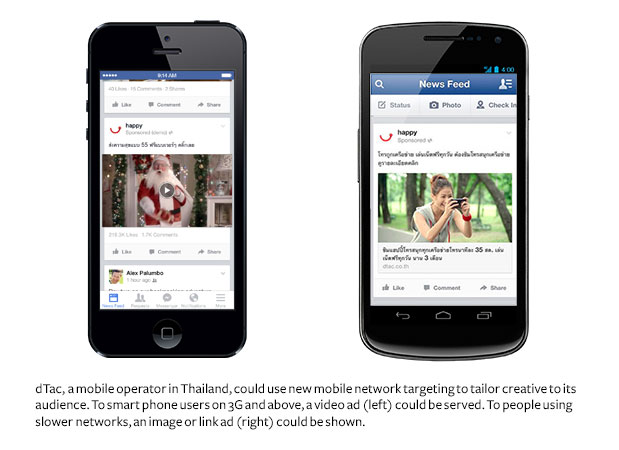
facebook bandwidth targetingThe technology is done on the fly, so an advertiser can serve a text or image ad to a 2G user while using rich media or a video ad for a 4G user.

The change is now live and advertisers can access this new targeting type through Ad Create tool, the Twitter Power Editor and the API.

  • Facebook
  • Twitter
  • Google+
  • Pinterest
  • LinkedIn
  • Email
  • WhatsApp
  • Evernote
  • SMS
The following two tabs change content below.
  • Bio
  • Latest Posts
My Twitter profileMy Facebook profileMy Google+ profileMy LinkedIn profile

Jennifer Slegg

Founder & Editor at The SEM Post
Jennifer Slegg is a longtime speaker and expert in search engine marketing, working in the industry for almost 20 years. When she isn't sitting at her desk writing and working, she can be found grabbing a latte at her local Starbucks or planning her next trip to Disneyland. She regularly speaks at Pubcon, SMX, State of Search, Brighton SEO and more, and has been presenting at conferences for over a decade.
My Twitter profileMy Facebook profileMy Google+ profileMy LinkedIn profile

Latest posts by Jennifer Slegg (see all)

  • 2022 Update for Google Quality Rater Guidelines – Big YMYL Updates - August 1, 2022
  • Google Quality Rater Guidelines: The Low Quality 2021 Update - October 19, 2021
  • Rethinking Affiliate Sites With Google’s Product Review Update - April 23, 2021
  • New Google Quality Rater Guidelines, Update Adds Emphasis on Needs Met - October 16, 2020
  • Google Updates Experiment Statistics for Quality Raters - October 6, 2020

Filed Under: Twitter Tagged With: bandwidth targeting

Sign up for our newsletter


Comments

  1. Marketing Bees says

    August 29, 2014 at 12:12 am

    I think this is one of the best changes Facebook made recently, for both advertisers and viewers

Founder & Editor

Jennifer Slegg (2052)

Sign up for our daily news recap & weekly newsletter.


Follow us online

  • Facebook
  • Google+
  • Linkedin
  • Pinterest
  • Twitter

Latest News

2022 Update for Google Quality Rater Guidelines – Big YMYL Updates

We finally have the first Google Quality Rater Guidelines update of 2022, and like usual, it is … [Read More...]

Recent Posts

  • 2022 Update for Google Quality Rater Guidelines – Big YMYL Updates
  • Google Quality Rater Guidelines: The Low Quality 2021 Update
  • Rethinking Affiliate Sites With Google’s Product Review Update
  • New Google Quality Rater Guidelines, Update Adds Emphasis on Needs Met
  • Google Updates Experiment Statistics for Quality Raters
  • Analyzing “How Google Search Works” Changes from Google
  • Google Quality Rater Guidelines Update: New Introduction, Rater Bias & Political Affiliations
  • Google Updates Quality Rater Guidelines: Reputation for News Sites; Video Content Updates; Quality for Information Sites
  • Google Makes Major Changes to NoFollow, Adds Sponsored & UGC Tags
  • Google Updates Quality Rater Guidelines Targeting E-A-T, Page Quality & Interstitials

Categories

  • Affiliate Marketing
  • Amazon
  • Apple
  • Bing
  • Branding
  • Browsers
  • Chrome
  • Content Marketing
  • Design
  • Domains
  • DuckDuckGo
  • Email
  • Facebook
  • Firefox
  • Foursquare
  • Google
    • Analytics
    • Google RankBrain
    • Quality Rater's Guidelines
  • History of Search
  • Industry Spotlight
  • Instagram
  • Internet Explorer
  • Links
  • Local
  • Mobile
  • Native Advertising
  • Other Search Engines
  • Pay Per Click
  • Pinterest
  • Publishers
  • Security
  • SEO
  • Snapchat
  • Social Media
  • State of the Industry
  • The SEM Post
  • Tools
  • Twitter
  • Uncategorized
  • User Experience
  • Video Marketing
  • Week in Review
  • Whitepapers
  • Wordpress
  • Yahoo
  • Yelp
  • YouTube
December 2025
MTWTFSS
« Aug  
1234567
891011121314
15161718192021
22232425262728
293031 

Meta

  • Log in
  • Entries RSS
  • Comments RSS
  • WordPress.org

Copyright © 2025 · News Pro Theme On Genesis Framework · WordPress · Log in